Copper peptides: GHK-Cu vs AHK-Cu vs copper-free GHK
Updated
In short
GHK-Cu and AHK-Cu are copper complexes of two tripeptides that differ by a single residue at the first position. The copper ion is integral to the activity described in the literature, not an additive. Copper-free GHK is supplied separately so that the copper-to-peptide ratio can be set deliberately rather than inherited from manufacture.
The three forms in the catalogue
| Product | Sequence | Copper | Typical use |
|---|---|---|---|
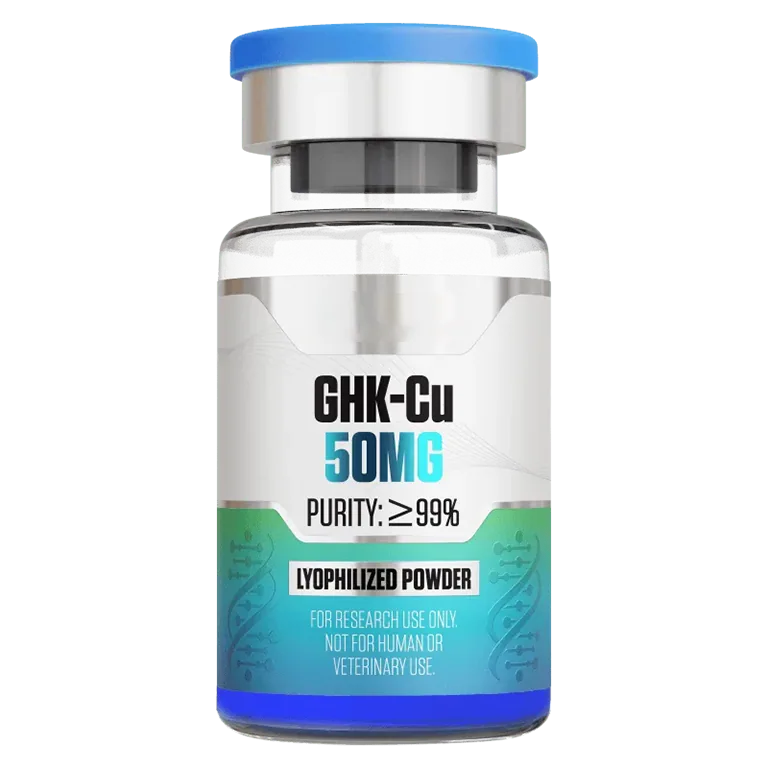
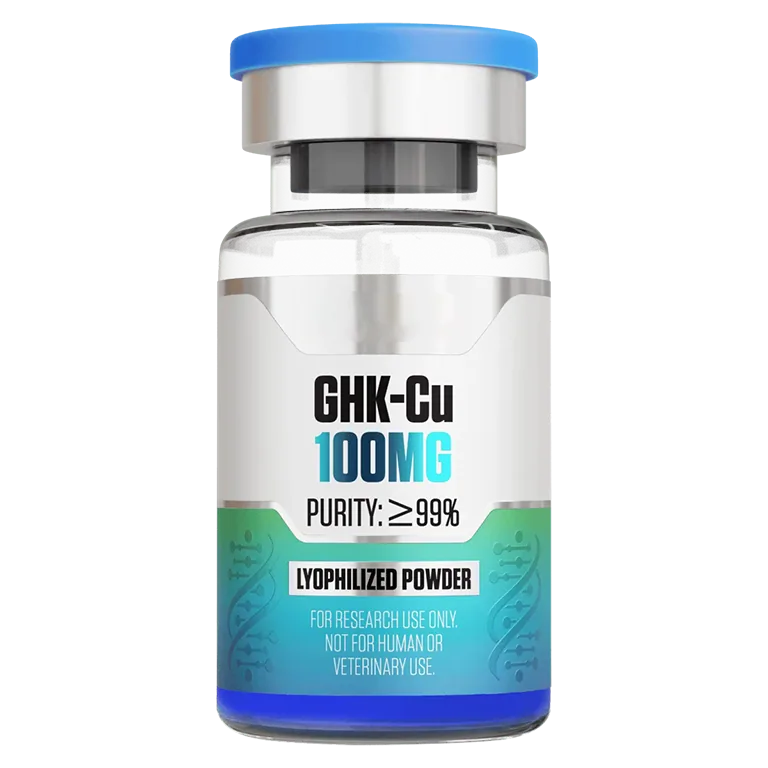
| GHK-Cu | Gly-His-Lys | Complexed | Matrix remodelling, dermal research |
| AHK-Cu | Ala-His-Lys | Complexed | Hair follicle and fibroblast work |
| GHK Basic | Gly-His-Lys | None | Studies that set the copper ratio deliberately |
Why the copper matters
GHK is a sequence found naturally in human plasma and released from collagen during tissue injury. Its affinity for copper(II) is the property most of the literature is built on — chelation is what distinguishes GHK-Cu from the copper-free tripeptide in matrix remodelling assays. Treating the copper as an optional additive misreads the chemistry.
GHK vs AHK: a single-residue comparison
The two differ only at the first position — glycine in GHK, alanine in AHK. That makes the pair unusually clean for testing sequence specificity: any difference in outcome is attributable to one residue rather than to a broader structural change. AHK-Cu appears most often in hair follicle work, GHK-Cu across dermal fibroblast and matrix studies.
When to choose the copper-free form
Supplying GHK without copper lets the ratio be a variable rather than a constant. If the experiment asks how much copper the effect requires, starting from the pre-formed complex makes that question unanswerable. The copper-free entry is also the right starting point for formulation work where another chelator is already present.
Choosing a fill size
The 50mg fills are sized for bench assay work; the 200mg fills are formulation-scale, listed under the INCI names formulators search for. The chemistry is the same — only the quantity differs.
Copper peptides in the catalogue
Frequently asked questions
- What is the difference between GHK and GHK-Cu?
- GHK is the copper-free tripeptide glycyl-L-histidyl-L-lysine. GHK-Cu is its copper(II) complex. The copper is integral to the activity described in the literature, so the two are not substitutes — the copper-free form is chosen when the copper-to-peptide ratio needs to be set deliberately.
- How do GHK-Cu and AHK-Cu differ?
- By a single residue at the first position: glycine in GHK, alanine in AHK. Both are copper complexes of a histidine-lysine tripeptide. AHK-Cu appears most often in hair follicle research, GHK-Cu across dermal fibroblast and matrix remodelling studies.
- Why is a copper peptide solution blue?
- The blue colour comes from the coordinated copper(II) ion. A colourless solution indicates the copper is no longer complexed to the peptide, which means the material is no longer the compound described on the label.
All products referenced are sold for research, laboratory, or analytical purposes only, and are not for human consumption.